


2027 Rate Changes - Michigan: +14.2% indy market; +9.6% sm. group market
Fri, 07/17/2026 - 5:01pm
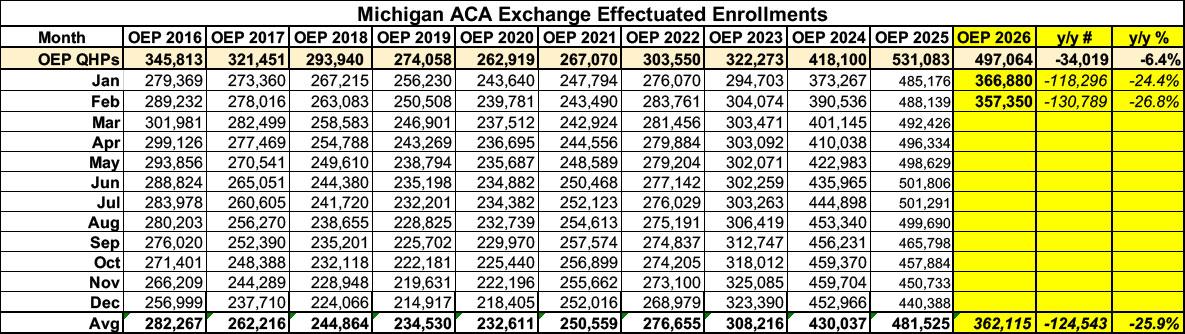
Before I begin, it's important to note that as in most states, ACA exchange enrollment has plummeted in Michigan since Congressional Republicans allowed the enhanced federal subsidies to expire at the end of last year: Effectuated enrollment was down 27% year over year as of February, and has almost certainly continued to drop further since then. That's at least 131,000 fewer Michiganders enrolled in ACA healthcare coverage this year.
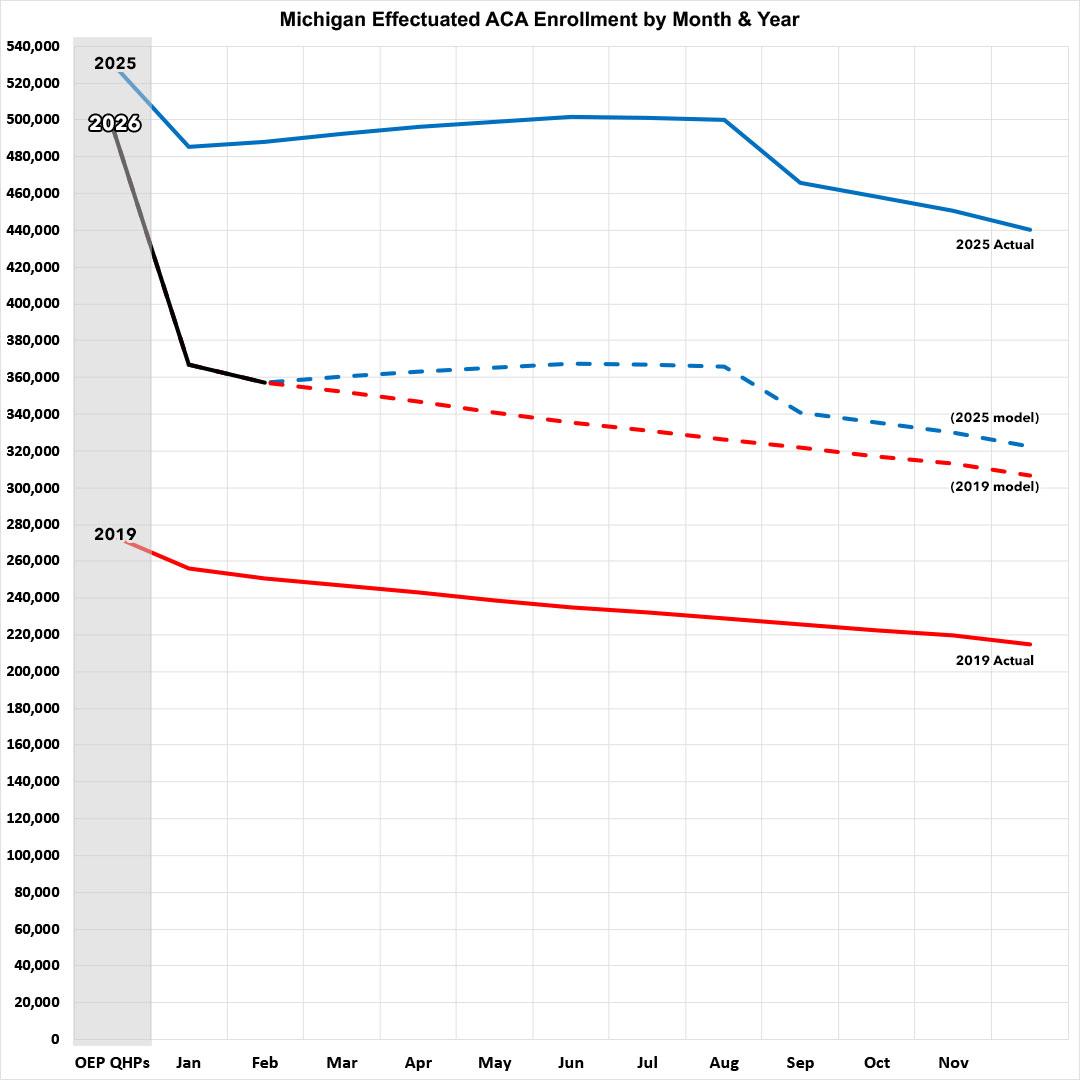
Here's what this looks like visually, with both 2025 and 2019 (the last pre-COVID year, which didn't include the enhanced subsidies) included for comparison:
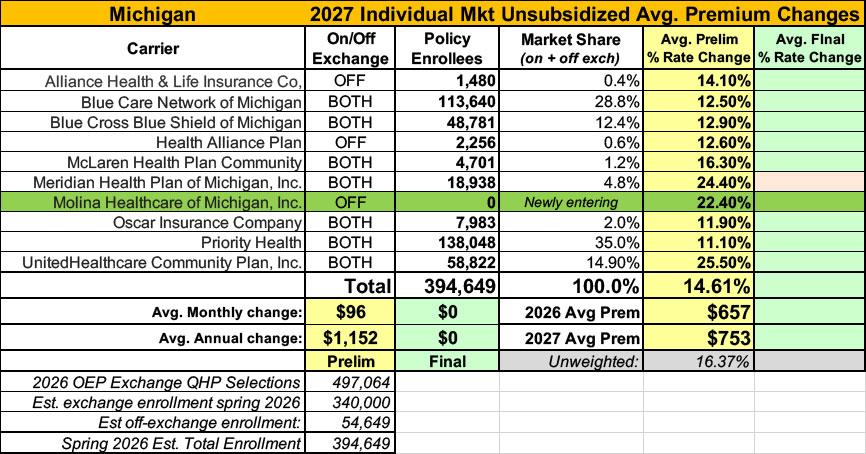
With that in mind, here's the key points from the 2027 actuarial filings from the various insurance carriers participating in the Michigan individual market next. year (note that Molina is newly entering the Michigan market):
via Alliance Health & Life Insurance Co:
4.3 PROPOSED RATE CHANGES
This filing reflects proposed rates for effective dates of January 1, 2027 through December 31, 2027. We develop premium rates for these Individual plans using AHL’s January 1, 2025 – December 31, 2025 Individual experience, in conjunction with internal research proprietary to AHL and other industry studies and surveys. We consider a number of items in developing the premium rates, including but not necessarily limited to:
- Projected morbidity level of the population anticipated to purchase the products
- Proposed benefit plan designs
- Anticipated medical trend, both utilization and cost of services
- Applicable taxes and fees, including those newly applicable since 2014 under ACA
- Anticipated risk adjustment payments (receipts)
This memorandum addresses the rate increase requested for AHL’s Individual PPO product, which impacts 2027 renewals. AHL’s total single risk pool has 1,480 members as of February 2026. The rate increase being requested, weighted by current enrollment for AHL’s products, is an aggregate 14.05%. The requested rate increase varies by plan and area with a minimum change of 13.9% and a maximum change of 14.1%. These rates are effective for 12 months beginning January 1, 2027.
Reason for Rate Change
The following are the key drivers of the requested rate change.
- Base Experience – AHL’s Individual ACA experience is the basis for AHL’s 2027 premium rates. AHL’s claims experience is driving rate deficiency of 8.3%.
- Trend – AHL’s 2027 annual claims trend is approximately 10.2%.
- Risk Adjustment – The projected risk adjustment receivable is increasing relative to the filing approved effective January 1, 2026. This impacts the rate change by 1.7%.
- Retention Charges – The load for retention is increasing relative to the filing approved effective January 1, 2026. This impacts the rate change by -6.1%.
via Blue Care Network of Michigan:
BCN is filing a year-over-year average rate increase for 2027 for all individual products that were offered in 2026 of 12.45%. Significant contributors to rate change are outlined in the table below:
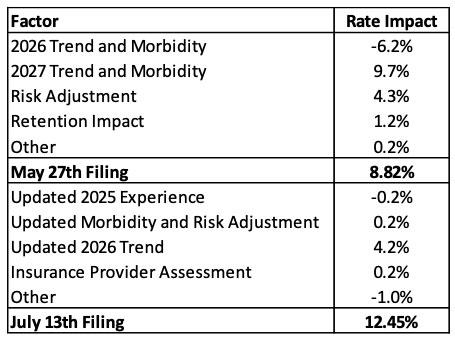
Note this is a revised filing and takes into account only information learned subsequent to the original filing, in compliance with DIFS Bulletin 2026-14-INS. Drivers of rate change relative to the initial filing include:
- The 2025 experience period used as a starting point for claims projection has been revised according to an additional two months of claims runout relative to the initial filing:
- Initial Filing: Incurred January 1st, 2025 to December 31st, 2025, paid through March 31st, 2026
- Current Filing: Incurred January 1st, 2025 to December 31st, 2025, paid through May 31st, 2026
- Trend in 2026 has been revised to incorporate year-to-date 2026 experience, which has emerged considerably higher than previously projected.
- Risk Adjustment has been revised to incorporate new information regarding actual 2025 risk adjustment results, and emerging 2026 morbidity and premium information.
- Assumed relative risk levels between BCN and other carriers has been revised based on emerging yearto-date 2026 experience, which has been incorporated into the above mentioned 2026 trend and risk adjustment estimate.
- Revisions to incorporate an updated Insurance Provider Assessment of $8.29 PMPM.
The above-mentioned changes encompass only new information that could not have been reasonably known when the rates were originally filed.
Additional detail around the assumptions utilized in the rate development process is included in the following sections of this memorandum.
Although the rates for each product were based on the projected experience for the single risk pool as noted in Section 12 of this memorandum, the rate changes vary by product and plan. While the primary drivers of rate change variation by plan are changes in cost sharing provisions and updates to the Paid to Allowed Ratios as described in Section 8 of this memorandum, changes in network discount and other model changes can also contribute to variations by plan. Rating impacts of ARPA Subsidy expiration are detailed in Section 22.
...BCN’s individual book of business is projected to decrease by 11.5% from experience period enrollment of approximately 95,000 members in 2025 to approximately 84,000 members in 2027. BCN used 2026 enrollment as the starting point for the 2027 membership projection. The key driver of the membership decrease is the ARPA subsidy expiration, though additional adjustments were made based on marketplace and historical trends as well as actions anticipated by competitor plans.
...Section 22: ARPA Impact
Impact of enhanced subsidy expiration: We are projecting an approximate 5% increase in rates driven by market morbidity, of which 4% is already realized in 2026.
Impact if enhanced subsidies are restored: We are projecting an approximate 2.5% rate reduction, driven by a decrease in rates due to improved market morbidity. However, we are not projecting a full reversal of the 5% noted above, as members that left the market may not return and there may be other market drivers that we will evaluate at that time. Thus we believe a range of impacts to be between 0% and 5.0%.
via Blue Cross Blue Shield of Michigan:
BCBSM is filing a year-over-year average rate increase for 2027 for all individual products that were offered in 2026 of 12.93%. Significant drivers of the rate change include:
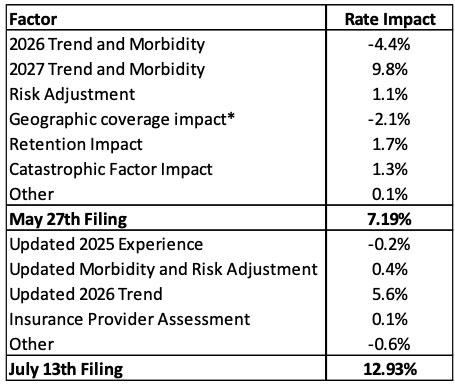
*The geographic coverage impact line represents the impact of discontinuing certain renewing plans within certain rating areas.
Note this is a revised filing and takes into account information learned subsequent to the original filing, in compliance with DIFS Bulletin 2026-14-INS. Drivers of rate change relative to the initial filing include:
- The 2025 experience period used as a starting point for claims projection has been revised according to an additional two months of claims runout relative to the initial filing:
- Initial Filing: Incurred January 1st, 2025 to December 31st, 2025, paid through March 31st, 2026
- Current Filing: Incurred January 1st, 2025 to December 31st, 2025, paid through May 31st, 2026
- Trend in 2026 has been revised to incorporate year-to-date 2026 experience, which has emerged considerably higher than previously projected
- Risk Adjustment has been revised to incorporate new information regarding actual 2025 risk adjustment results, and emerging 2026 morbidity and premium information.
- Assumed relative risk levels between BCBSM and other carriers has been revised based on emerging year-to-date 2026 experience, which has been incorporated into the above-mentioned 2026 trend and risk adjustment estimate.
- Revisions to incorporate an updated Insurance Provider Assessment of $8.29 PMPM.
The above-mentioned changes encompass only new information that could not have been reasonably known when the rates were originally filed.
Additional detail around the assumptions utilized in the rate development process is included in the following sections of this memorandum.
Although the rates for each product were based on the projected experience for the single risk pool as noted in Section 12 of this memorandum, the rate changes vary by product and plan. While the primary drivers of rate change variation by plan are changes in cost sharing provisions and updates to the Paid to Allowed Ratios as described in Section 8 of this memorandum, changes in network discount and other model changes can also contribute to variations by plan. Rating impacts of ARPA Subsidy expiration are detailed in Section 22.
...BCBSM’s individual book of business is projected to decrease by 30.3%, from experience period enrollment of approximately 58,000 members in 2025 to approximately 40,000 members in 2027. BCBSM used 2026 enrollment as the starting point for the 2027 membership projection. The key driver of the membership decrease is the ARPA subsidy expiration, though additional adjustments were made based on marketplace and historical trends.
...Impact of enhanced subsidy expiration: We are projecting an approximate 5% increase in rates driven by market morbidity, of which 4% is already realized in 2026.
Impact if enhanced subsidies are restored: We are projecting an approximate 2.5% rate reduction, driven by a decrease in rates due to improved market morbidity. However, we are not projecting a full reversal of the 5% noted above, as members that left the market may not return and there may be other market drivers that we will evaluate at that time. Thus we believe a range of impacts to be between 0% and 5.0%.
via Health Alliance Plan:
4.3 PROPOSED RATE CHANGES
This filing reflects proposed rates for effective dates of January 1, 2027 through December 31, 2027.
We develop premium rates for these Individual plans using HAP’s January 1, 2025 – December 31, 2025 Individual experience, in conjunction with internal research proprietary to HAP and other industry studies and surveys. We consider several items in developing the premium rates, including but not necessarily limited to:
- Projected morbidity level of the population anticipated to purchase the products
- Proposed benefit plan designs
- Anticipated medical trend, both utilization and cost of services
- Applicable taxes and fees, including those newly applicable since 2014 under ACA
- Anticipated risk adjustment payments (receipts)
This memorandum addresses the rate increase requested for HAP’s Individual HMO product, which impacts 2027 renewals. HAP’s total single risk pool has 2,256 members as of February 2026. The rate change being requested, weighted by current enrollment for HAP’s products, is an aggregate 12.60%. The requested rate change varies by plan and area with a minimum change of 12.6% and a maximum change of 12.6%. These rates are effective for 12 months beginning January 1, 2027.
Reason for Rate Change
The following are the key drivers of the requested rate change.
- Base Experience – HAP’s Individual ACA experience is the basis for HAP’s 2027 premium rates. HAP’s claims experience is driving rate deficiency of 3.8%.
- Trend – HAP’s 2027 annual claims trend is approximately 10.0%.
- Risk Adjustment – The projected risk adjustment payable is increasing relative to the filing approved effective January 1, 2026. This impacts the rate change by 4.9%.
- Retention Charges – The load for retention is increasing relative to the filing approved effective January 1, 2026. This impacts the rate change by -6.2%.
via McLaren Health Plan:
McLaren will sell individual policies with effective date of January 1 st , 2027.
...The average annual premium for 2027 is $10,328.89, which is $860.74 PMPM (4.21 of URRT WK2 x 12). The average annual premium for 2026 is $8,646.07, which is $720.51 PMPM (2.13 of URRT WK2 x 12). As of March 2026, there are 3,191 policy holders and 4,701 covered lives affected by this proposed rate change. The average overall rate increase is 16.25% (1.12 of URRT WK2).
We have applied an explicit 1.032 morbidity adjustment due to expected market changes based on the expiration of the enhanced Premium Tax Credits (ePTC) made available under the American Rescue Plan Act, as well as additional policy considerations.
...A morbidity adjustment was applied to 2024 McLaren experience to translate base morbidity to 2027 projected morbidity. We estimated expected differences in the morbidity defined as plan liability risk score (2024 HHS model) normalized by the average induced demand, the average actuarial value, and demographic factor between the base period and the projection period. Because this ratio includes components of age and area, we back out the Step 6 manual demographic adjustment to arrive at a WACA morbidity adjustment shown in Step 7 of Appendix A. An additional morbidity adjustment was made due to reflect the policy adjustment described above. We applied the same adjustment as described in the experience portion of the memorandum.
via Meridian Health Plan of MI:
Reasons for Rate Increase(s):
The rate projections for 2027 have been updated from the previous year’s projections to reflect the most recent assumptions and information available.
The following provides a narrative description of the significant factors driving the proposed rate increase for 2027.
- Single Risk Pool Experience and Morbidity (10.8% of premium impact versus 2026 filed rates)
The individual single risk pool experience underlying the rate projections has been updated. The current model reflects the projected utilization trend applied to adjusted experience (from 2025 to 2027), including anticipated changes in the average morbidity of the single risk pool. There is a full description of utilization trend and other projection factors applied to experience in Section 6, ’Trend Factors’.
Risk adjustment transfer experience for 2027 includes consideration of changes to the statewide average premium, the Risk Adjustment program, and Meridian Health Plan of Michigan enrollee population morbidity relative to the Michigan single risk pool.
- Unit Cost trend ( 6.5% of premium impact versus 2026 filed rates) Unit costs and provider reimbursement agreements have been updated to reflect changes in the rating year.
- Utilization trend ( 3.3% of premium impact versus 2026 filed rates)
The projected utilization trends are consistent with observed historical trends based on internal analysis of our marketplace experience, supplemented by the Milliman Health Cost Guidelines. There is a description of the Health Cost Guidelines in Section 8, "Manual Rate Adjustments".
- Changes in Administrative Expenses and Profit ( 2.1% of premium impact versus 2026 filed rates)
Changes in general administrative expenses incorporated into 2027 rates are resulting in a rate change due to differences from prior year expense assumptions. See Section 12, "Plan Adjusted Index Rate", for details on projected non-benefit expenses. Note that the requested rate change may not be the same across all plans within a product due to changes to the member cost sharing amounts by plan. Additionally, the defunding of CSR subsidies has contributed to the rate levels being higher than if the subsidies were to be funded.
...Impact of eAPTC Expiration
To account for eAPTC expiration prior to the 2027 benefit year, we have assumed rates will increase due to anticipated reductions in enrollment, both at the issuer and single risk pool level. As eAPTCs expire and enrollees subsequently face increased out-of-pocket premiums, we assume healthier individuals who tend to be more price sensitive will leave the market, worsening the average morbidity of the individual risk pool.
via Molina Healthcare of MI:
(newly entering the Michigan market)
This filing assumes CSRs remain unfunded throughout 2027. Rates and assumptions contained herein are no longer actuarially sound if this changes for plan year 2027. If the regulatory environment changes, Molina will work with the state to incorporate changes in an actuarially sound manner.
Molina’s rate filing reflects the following rate changes by metal tier for Molina’s membership. Molina has 0 members in plans that are renewing and 0 members in plans that are terminating for a total of 0 members enrolled effective March 2026 and reported as of April 2026. Similarly, Molina has 0 policyholders in plans that are renewing and 0 policyholders in plans that are terminating for a total of 0 policyholders. The rate change calculation below is consistent with Worksheet 2, Section II of the URRT, which only includes members and policyholders on renewing plans. Since Molina does not have any members for 2026, the rate change result is zero.
The rate changes vary by metal tier due to changes in the Actuarial Value (AV) Pricing Values assigned to each metal plan that are applied to the Plan Adjusted Index Rate.
via Oscar Insurance Co:
3. Proposed Rate Increases Reason for Rate Increase(s)
Exhibit A summarizes the proposed rate increases by plan effective January 1, 2027. Rate increases vary by plan due to a combination of factors including shifts in benefit leveraging, cost-sharing modifications, and geographic rating factors. Using in-force business as of March 2026, the proposed average rate change for renewing plans is 11.9%. This rate change is absent of rate changes due to attained age.
The significant factors driving the proposed rate change are described in the following attribution summary and are displayed quantitatively in Table 1.
- Description / Value
- Claim Experience in 2025 8.7%
- Market Morbidity 3.1%
- Medical and Prescription Drug Trend -1.0%
- Prospective Benefit Changes -0.1%
- Admin, Taxes and Fees, and Risk Margin 1.2%
- Total 11.9%
Anticipated Changes in the Average Morbidity of the Covered Population
Changes to the overall premium level are needed because of anticipated changes in the underlying morbidity of the projected marketplace.
Medical and Prescription Drug Inflation and Utilization Trends
The projected premium rates reflect the most recent emerging experience which was trended for anticipated changes due to medical and prescription drug inflation and utilization. Average cost trends were developed based on Oscar’s anticipated reimbursement levels. Utilization trends were developed at the broad service category level: inpatient facility, outpatient facility, professional, other, and prescription drugs.
Prospective Benefit Changes
Plan benefits have been revised as a result of changes in the Center for Medicare and Medicaid Services (CMS) Actuarial Value Calculator and state requirements, as well as for strategic product considerations.
Administrative Expenses, Taxes and Fees, and Risk Margin
Changes to the overall premium level are needed because of required changes in federal and state taxes and fees. In addition, there are anticipated changes in both administrative expenses and targeted risk margin.
...Morbidity Adjustment
An adjustment was included to reflect changes in the anticipated market morbidity in response to the uncertainty inherent in the marketplace. Specifically, Oscar anticipated changes to the market morbidity associated with the change in Michigan’s enrollment for the projection period relative to the experience period, due to the ending of the enhanced subsidies introduced by the American Rescue Plan Act, as well as the several new enrollment and eligibility procedures and requirements introduced by regulations including, but not limited to, the 2025 Marketplace Integrity and Affordability Proposed Rule and the HHS Notice of Benefit and Payment Parameters for 2027 Proposed Rule.
This adjustment reflects the projected change in claim costs outside of the underlying demographics of the covered population and is also assumed when estimating the risk adjustment transfer for the projection period.
A factor of 1.078 is included in the “Morbidity Adjustment” entry on Worksheet 1, Section II of the URRT
via Priority Health:
The reasons for the rate change include:
- Updated experience upon which the rates are based.
- Updated medical and prescription Rx cost and utilization trends.
- Updated benefit relative values, which may cause variation in rate changes by plan.
- Prospective benefit adjustments to existing products; the benefit relative values have been updated, which may cause variation in rate changes by plan.
- Anticipated morbidity impact from the continued impacts of EPTC subsidy expiration in 2026.
- Anticipated changes in the payments to the Federal Risk Adjustment program incorporating the estimated 2025 Risk Adjustment Transfer Payment.
- Updated factors for administrative expenses and margin. With this filing, the margin varies by plan.
- Updated taxes and fees.
- Updated Silver CSR Load.
The overall average annual increase which will be experienced by members over January 1, 2026 filed rates is an 11.08% increase.
via UnitedHealthcare Community Plan:
UHC will sell Individual policies with an effective date of January 1, 2027. The 2027 aggregate rate change as shown on the Unified Rate Review Template (URRT) is 25.54%. Rate changes by plan are found in Worksheet 2, row 1.11 of the URRT. The quantitative impact for all significant factors driving the proposed rate change is shown in the table below.
- Components of Rate Change / % Change
- Base Experience 6.9%
- Trend 11.4%
- Regulatory Morbidity 2.5%
- Benefit Design and CSR Load 4.6%
- Non-Benefit Expenses -1.4%
- Other -0.3%
- Total 25.54%
EXPIRATION OF ENHANCED SUBSIDIES
A 1.173 adjustment was applied to account for the expiration of enhanced premium subsidies passed under the American Rescue Plan Act (ARP) and extended by the Inflation Reduction Act (IRA). Due to the expiration of the enhanced premium subsidies effective 1/1/2026, UHC observed a decline in enrollment due to higher post-subsidy premiums. Healthier members are expected to leave at a disproportionately higher rate than those with significant healthcare needs, increasing market morbidity in 2026. This estimate is based on internal modeling using historical Wakely National Risk Adjustment Reporting (WNRAR) data, Marketplace Open Enrollment Period Public Use Files, and Wakely Early Enrollment Reporting for 2026
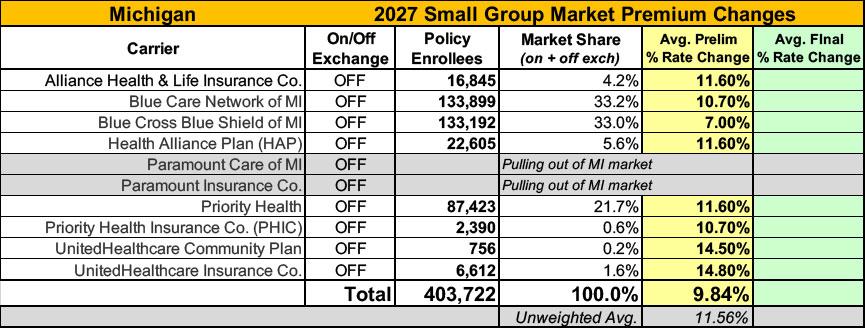
Put them all together and you get the following, although according to the official Michigan Dept. of Insurance & Financial Services summary page the weighted averages are slightly lower for both the Individual and Small Group markets for some reason:
Advertisement


