


2027 Rate Changes - California: +9.9% indy market
Tue, 07/21/2026 - 2:06pm
Before I begin, it's important to note that ACA exchange enrollment has dropped in California since Congressional Republicans allowed the enhanced federal subsidies to expire at the end of last year...although thanks to the state providing its own supplemental financial subsidies to partially cancel out the lost federal subsidies, it's not nearly as dramatic a drop-off as in most other states.
Effectuated enrollment was down 9.5% year over year as of March, and has almost certainly continued to drop further since then based on the trend line (see below). That's at least 187,000 fewer Californians enrolled in ACA healthcare coverage this year.
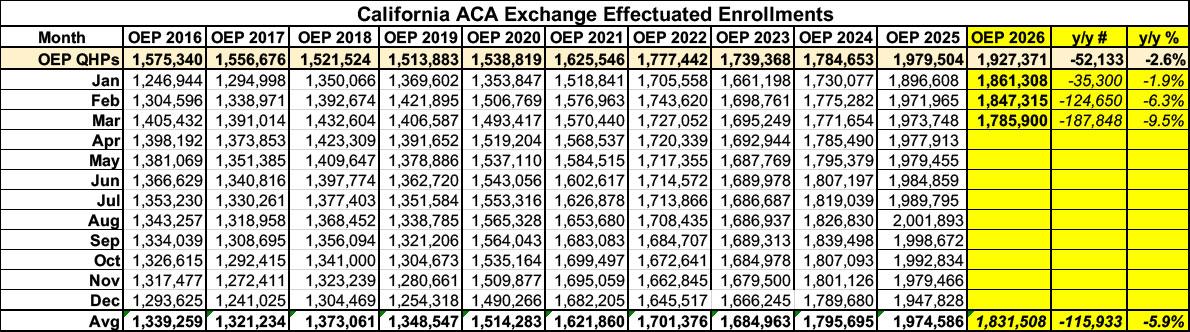
Here's what this looks like visually, with both 2025 and 2019 (the last pre-COVID year, which didn't include the enhanced subsidies) included for comparison:

With that in mind, here's the full press release via Covered California:
SACRAMENTO, Calif. — Covered California announced its health plans and rates for the 2027 coverage year, with a preliminary weighted average rate increase of 9.9 percent and one new carrier entering the marketplace in 2027. Many enrollees can lessen the impact of increasing rates by shopping and switching to more affordable plans.
The proposed rate change can be attributed to many factors, including the increasing cost of health care and pharmacy expenditures alongside broader industry challenges. Additionally, actions taken by the federal government have driven up prices for consumers. Last year, federal lawmakers failed to extend enhanced federal tax credits that helped millions of Americans afford their monthly premiums. This year, the Trump administration cut eligibility for lawfully present immigrants, added administrative burdens to families applying for financial help and made it more difficult for gig workers who have to recalculate their income on an annual basis.
“The federal government and this administration have made it more difficult for hard-working Americans to access high-quality health insurance at a price they can actually afford,” said Covered California Executive Director Jessica Altman. “The fallout from these federal actions continues to reduce affordability and put health insurance out of reach for too many — something our state is fortunately counteracting.”
California is continuing to fight for affordability and health care access by adding more insurance options and expanding the state’s subsidy program that will help one in four enrollees reduce their monthly premium.
“Since Republicans have not been able to repeal the Affordable Care Act, this administration has instead tried to do all it can to weaken and spread misinformation about ACA marketplaces like Covered California. Unfortunately for them, it’s not working,” said Governor Gavin Newsom. “California continues to lead the way in providing vital access to affordable health insurance. Our original subsidy program was an inspiration for the enhanced premium tax credits nationally that expired at the end of last year, and our expanded state subsidy program shows a path forward to protect affordability for the most vulnerable Americans.”
Expanded State Subsidy Program Reaching More Californians and Supporting the Most Vulnerable
In 2026, Gov. Newsom and the California Legislature increased the amount of state funds available for the Covered California State Subsidy Program, appropriating $300 million in Health Care Affordability Reserve Fund (HCARF), up from $190 million. As a result, Californians with incomes up to 200 percent of the federal poverty level in 2027 ($31,920 for an individual or $66,000 for a family of four) will be eligible for financial help to lower the cost of monthly premiums.
It's important to note that in 2026, the CA State Subsidy Program fully backfills lost federal subsidies for enrollees earning up to 150% FPL and provides a small subsidy for those earning 150 - 165% FPL. I'm not sure whether the expansion up to 200% FPL fully backfills them or not.
While the state subsidy program is not enough to fill the gap left by the expiration of enhanced federal subsidies, more than 500,000 Californians are projected to receive a state subsidy in 2027, about 30 percent of all enrollees. Additionally, nearly 200,000 can choose from two Silver-tier plans with a $0 premium.
“Investing in the health of our residents is good for people. It’s also good policy,” said Governor Newsom. “The federal government has decided that health care affordability is not a priority, so California is stepping up once again to help families most in need across our state.”
Covered California estimates the state subsidy program will open financial help to an additional 200,000 Californians who weren’t eligible in 2026 and prevent 90,000 people from dropping coverage in 2027.
“When people have access to health insurance, they face less risk of financial hardship due to a medical issue, they miss fewer days of work, and they’re able to contribute more to their families and communities,” said Altman. “We’re grateful for Gov. Newsom and the California Legislature for passing these critical investments to help more Californians get connected to the coverage they need.”
California’s Individual Market Changes for 2027
Despite ongoing federal rule changes that affect eligibility and affordability, Covered California maintains a strong marketplace, with 1,785,000 enrollees as of March 2026, and engages in active negotiations with health insurance companies to help keep Covered California one of the most affordable options for health insurance.
This has helped ensure that California’s rate increase of 9.9 percent is significantly lower than the preliminary national median rate increase of 14 percent. It’s also why for most of the past decade, the average cost for a benchmark plan in California has been lower than the national average.
I should note that my own calculations put the national average preliminary rate increase at around 14.6% across 17 states (including California).
Covered California’s 9.9 percent increase for 2027 reflects an average of proposed rates across all health insurance companies that offer individual plans. As it does every year, actual rates can differ greatly by plan and region. They are subject to final review and public comment by California’s Department of Managed Health Care (see Table 1: Covered California Individual Market Rate Changes by Rating Region and Table 2: California Individual Market Rate Changes by Carrier). Final rates will take effect on Jan. 1, 2027.
Covered California Continues to Provide Affordability, Value
Despite rising premiums and declining enrollment across the country, Covered California has connected 1.785 million Californians to health insurance this year, the second highest mark in its history.
“It really shows the value of having a Covered California plan, that even when prices increase, people are choosing to keep or switch their health plans rather than lose insurance altogether,” said Altman. “It’s clear that once people get access to health insurance, they want to keep it, so it is critical that we continue to fight and find ways to make that access affordable for all Californians.”
Despite a weighted average rate increase of 9.9 percent, most Covered California enrollees will be protected from higher monthly premiums. Thanks to existing federal tax credits and California’s expanded subsidy program, 60 percent of enrollees will see no increase in their monthly premium, 26 percent will remain eligible for $0 premiums without changing plans, and many others may actually pay less each month.
Another way to reduce costs for consumers is to increase competition and options. In 2027, 12 health insurance carriers will offer plans across the state, ensuring that all Californians have access to two or more choices. Additionally, 92 percent will be able to choose from three carriers or more, and nearly 75 percent will have four or more carriers to choose from.
All of this works together to help make health insurance as affordable as possible for families across California:
- A couple in Los Angeles earning around $38,000 could get a Bronze plan with a $0 monthly premium.
- A family of four in Sacramento with an income around $82,000 could get a Silver plan for less than $580 a month.
- A family of three in Orange County earning around $41,000 a year could get a Silver plan for less than $240 a month.
Additionally, one new insurance company, CalOptima Health, is entering the marketplace in 2027 in Region 18 to serve Orange County, while Molina Healthcare will no longer offer marketplace plans in Regions 15 and 18. Molina’s approximately 1,600 enrollees in these regions will be allowed to choose a new plan or move to the carrier with the lowest-cost plan in the same metal tier.
Covered California’s commitment to affordability and access remains unwavering. Its proactive approach to negotiating rates, combined with state subsidies, showcases California’s leadership in advancing the goals of the Affordable Care Act and protecting individuals and families during times of rapidly increasing costs of living.
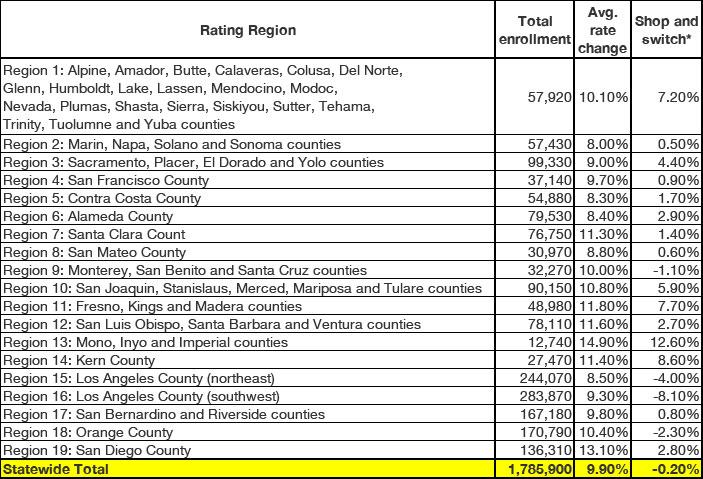
- Shop and switch refers to the average rate change consumers could see if they shop around and switch to the lowest-cost plan in their current metal tier.
Plan options and prices differ depending on the region. For plan information in your area, Covered California recommends comparing plans online on CoveredCA.com. After entering some basic information like your income and location, you can find out what plans are available in your area, what they cover, how much they cost, and what kinds of financial help and programs you may be eligible to receive.
Current Covered California enrollees can choose to renew or switch their plans beginning Oct. 1. You can review your options at any time on CoveredCA.com. Open enrollment, which is when anyone can sign up for a plan, runs for three months beginning Nov. 1 and ending Jan. 31, 2027.
It's important to note that these figures include on-exchange enrollment only; I estimate that there's perhaps another ~200,000 or so Californians enrolled in off-exchange individual market policies (including with Sutter Health, which doesn't list any enrollees below because they only offer off-exchange plans). However, I doubt that those extra ~200K would move the needle significantly one way or the other in terms of weighted average premium changes:

Advertisement


