


2027 Rate Changes - South Carolina: +17.2% indy market; +8.6% small group market
Thu, 08/20/2026 - 9:10am
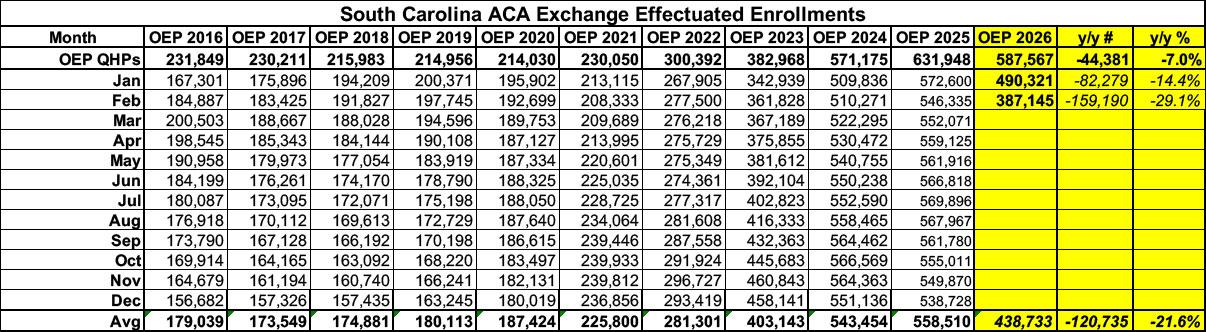
ACA exchange enrollment has dropped by nearly 30% in South Carolina since Congressional Republicans allowed the enhanced federal subsidies to expire at the end of last year.
Initial signups during Open Enrollment were only down 7% vs. OEP 2025...but effectuated enrollment plummeted by 14% in January and a whopping 29.1% as of February vs. a year earlier.
That's nearly 160,000 South Carolina residents who lost coverage in just the first two months of the year...a number which has likely continued to climb since then.
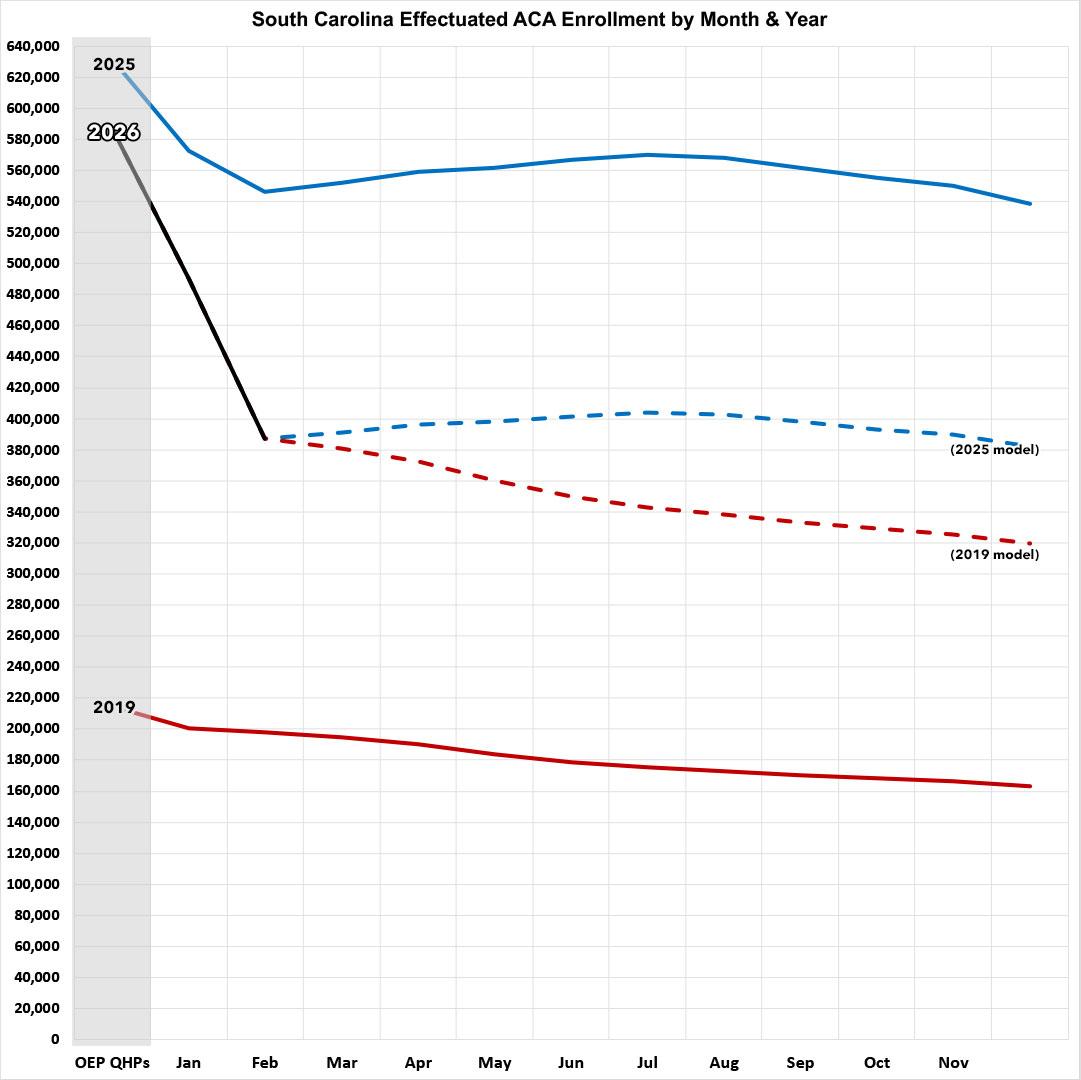
Here's what this looks like visually, with both 2025 and 2019 (the last pre-COVID year, which didn't include the enhanced subsidies) included for comparison:
Looking ahead to 2027, the preliminary rate filings for both the individual and small group markets are now available via the federal Rate Review database:
ABSOLUTE TOTAL CARE:
Absolute Total Care is filing rates for the individual block of business, effective January 1, 2027. This document is submitted in conjunction with the Part I Unified Rate Review Template and the Part III Actuarial Memorandum.
This information is intended for use by the South Carolina Department of Insurance, the Center for Consumer Information and Insurance Oversight (CCIIO), and health insurance consumers in South Carolina to assist in the review of Absolute Total Care’s individual rate filing. The results are actuarial projections. Actual experience will differ for a number of reasons, including population changes, claims experience, and random deviations from assumptions.
In 2025, earned premium was $550.70 per member per month (PMPM). Incurred claims in 2025 were $517.43, or 93.96% of premium. Netting risk adjustment from the claims results in an estimated loss ratio (incurred claims net of estimated risk adjustment transfers, divided by earned premiums) of 84.80%. We expect unit costs to increase for 2027. Further, we have updated underlying experience for the single risk pool, expected administrative expense, and assumptions for federal risk adjustment. These factors, as well as changes to the assumed morbidity of the single risk pool and medical trend, result in a premium rate increase.
Medical trend, or the increase in health care costs over time, is composed of two components: the increase in the unit cost of services and the increase in the utilization of those services. Unit cost increases occur as care providers and their suppliers raise their prices. Utilization increases can occur as people seek more services than before. Additionally, simple services can be replaced with more complex services over time, which is known as service intensity trend. An example of service intensity trend would be the replacement of an X-ray with an MRI scan. Replacing the service with a more intense service causes the total cost of medical services to increase.
The proposed rate change of 22.1% applies to approximately 67,070 individuals. Absolute Total Care’s projected administrative expenses for 2027 are $103.58 PMPM. Administrative expense does not include $16.12 for taxes and fees. The historical administrative expenses for 2026 were $90.21 PMPM, which excludes taxes and fees. The projected loss ratio is 83.1% which satisfies the federal minimum loss ratio requirement of 80.0%.
BLUECROSS BLUESHIELD OF SC:
Depending on the plan selected, approximately 300,000 members currently enrolled in a BlueEssentials, BlueExtend, BlueConnect, Blue Cooper, Blue Reedy, Blue Congaree, Blue Beaufort, or Blue Pee Dee Individual health plan will see an adjustment to premiums effective January 1st, 2027. The average premium increase across all products is projected at 14.8%.
Financial experience of the product:
During 2025, premiums received have likely been sufficient to cover claims paid, administrative costs, commissions, taxes, and fees. The rate adjustment effective January 1, 2027, is needed to cover future changes in medical costs as well as impacts of regulatory policy changes in the Individual market. If, in 2027, paid claims are significantly less than anticipated, rebates will be paid to Individual ACA members.
Changes in medical service costs:
BlueCross BlueShield of South Carolina will likely pay more claims in 2027 for the following reasons:
- Hospitals and doctors charging more for services.
- More individuals seeking treatment.
- Higher drug costs.
Changes in benefits:
Changes to deductibles, copayments, and out-of-pocket maximums on some products were implemented to limit the amount of the necessary rate change without sacrificing coverage.
Administrative costs and anticipated margins:
Administrative costs were set based on internal corporate estimates of normal operating costs. Federally required fees also apply. BlueCross BlueShield of South Carolina is working hard to find ways to lower these costs through intensive review of current practices.
BLUECHOICE HEALTHPLAN OF SC:
Depending on the plan selected, approximately 4,600 members currently enrolled in an Individual health plan will see an adjustment to premiums effective January 1st, 2027. The average premium increase across the block is projected at 23.4%.
Financial experience of the product:
During 2025, premiums received have likely been sufficient to cover claims paid, administrative costs, commissions, taxes, and fees. The rate adjustment effective January 1, 2027 is intended to cover future changes in medical costs. If, in 2027, paid claims are significantly less than anticipated, rebates will be paid to Individual ACA members.
Changes in medical service costs:
BlueChoice HealthPlan, Inc. will likely pay more claims in 2027 for the following reasons:
- Hospitals and doctors charging more for services.
- More individuals seeking treatment.
- Higher drug costs.
Changes in benefits:
Changes to deductibles, copayments, and out-of-pocket maximums for some products were implemented to limit the amount of the necessary rate change without sacrificing coverage.
Administrative costs and anticipated margins:
Administrative costs were set based on internal corporate estimates of normal operating costs. Federally required fees also apply. BlueChoice HealthPlan, Inc. is working hard to find ways to lower these costs through intensive review of current practices.
CELTIC INSURANCE (AMBETTER);
Celtic Insurance Company is filing rates for the individual block of business, effective January 1, 2027. This document is submitted in conjunction with the Part I Unified Rate Review Template and the Part III Actuarial Memorandum.
This information is intended for use by the South Carolina Department of Insurance, the Center for Consumer Information and Insurance Oversight (CCIIO), and health insurance consumers in South Carolina to assist in the review of Celtic Insurance Company’s individual rate filing. The results are actuarial projections. Actual experience will differ for a number of reasons, including population changes, claims experience, and random deviations from assumptions.
In 2025, earned premium was $532.57 per member per month (PMPM). Incurred claims in 2025 were $542.76, or 101.91% of premium. Netting risk adjustment from the claims results in an estimated loss ratio (incurred claims net of estimated risk adjustment transfers, divided by earned premiums) of 114.36%. We expect unit costs to increase for 2027. Further, we have updated underlying experience for the single risk pool, expected administrative expense, and assumptions for federal risk adjustment. These factors, as well as changes to the assumed morbidity of the single risk pool and medical trend, result in a premium rate increase.
Medical trend, or the increase in health care costs over time, is composed of two components: the increase in the unit cost of services and the increase in the utilization of those services. Unit cost increases occur as care providers and their suppliers raise their prices. Utilization increases can occur as people seek more services than before. Additionally, simple services can be replaced with more complex services over time, which is known as service intensity trend. An example of service intensity trend would be the replacement of an X-ray with an MRI scan. Replacing the service with a more intense service causes the total cost of medical services to increase.
The proposed rate change of 23.2% applies to approximately 1,316 individuals. Celtic Insurance Company’s projected administrative expenses for 2027 are $109.42 PMPM. Administrative expense does not include $12.80 for taxes and fees. The historical administrative expenses for 2026 were $84.01 PMPM, which excludes taxes and fees. The projected loss ratio is 85.0% which satisfies the federal minimum loss ratio requirement of 80.0%.
INSTIL HEALTH INSURANCE:
Depending on the plan selected, approximately 2,500 members currently enrolled in an InStil Individual health plan will see an adjustment to premiums effective January 1st, 2027. The average premium increase across all plans is projected at 23.3%.
Financial experience of the product:
During 2025, premiums received have likely been insufficient to cover claims paid, administrative costs, commissions, taxes, risk adjustment transfers, and fees. The rate adjustment effective January 1, 2027, is needed to cover future changes in medical costs as well as impacts of regulatory policy change in the Individual market. If, in 2027, paid claims are significantly less than anticipated, rebates will be paid to Individual ACA members.
Changes in medical service costs:
InStil will likely pay more claims in 2027 for the following reasons:
- Hospitals and doctors charging more for services.
- More individuals seeking treatment.
- Higher drug costs.
Changes in benefits:
Changes to deductibles, copayments, and out-of-pocket maximums for some products were implemented to limit the amount of the necessary rate change without sacrificing coverage.
Administrative costs and anticipated margins:
Administrative costs were set based on internal corporate estimates of normal operating costs. Federally required fees also apply. InStil Health Insurance Company is working hard to find ways to lower these costs through intensive review of current practices.
MOLINA HEALTHCARE OF SC:
Molina’s rate filing reflects the following rate changes by metal tier for Molina’s membership. Molina has [REDACTED] members enrolled effective March 2026 and reported as of April 2026. The rate change calculation below is consistent with Worksheet 2, Section II of the URRT, which only includes members on renewing plans.
The rate changes vary by metal tier due to changes in the Actuarial Value (AV) Pricing Values assigned to each metal plan that are applied to the Plan Adjusted Index Rate.
[REDACTED]
SELECT HEALTH OF SC:
[REDACTED]
UNITEDHEALTHCARE OF SC:
UHC is filing 2027 rates for individual products. The proposed rate change is [Redacted: TRADE SECRET] and will affect [Redacted: TRADE SECRET] individuals. The rate changes vary between [Redacted: TRADE SECRET] and [Redacted: TRADE SECRET]. Given that the rate changes are based on the same single risk pool, the rate changes vary by plan due to plan design changes.
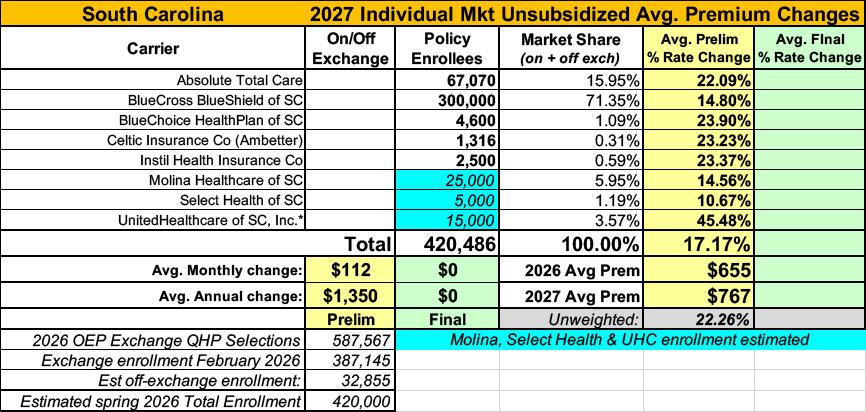
Unfortunately, as you can see above, the actuarial memos for Molina, SelectCare and UnitedHealthcare are all heavily redacted, meaning I don't know what their effectuated enrollment tallies are. I've made rough guesstimates based on each of their March 2025 enrollment numbers (42.6K, 6.2K and 26.4K respectively), knocking these down to 25K, 5K and 15K which brings the grand statewide total up to around 420,000 enrollees, which seems about right given the confirmed on-exchange enrollment of 387K as of February.
Marketwide (and assuming my estimates for Molina, Select Care and UnitedHealthcare are reasonably close), the weighted average increase being requested for 2027 is 17.2%. Being off significantly on Molina wouldn't move the needle much; being off on SelectHealth could lower the average slightly. If UHC's enrollment is significantly higher, that would raise the average.
As for South Carolina's small group market, the carriers there are seeking unweighted premium increases averaging around 8.6%.

Advertisement


