


2027 Rate Changes - Wisconsin: +21.1% indy market; +13.3% small group market
Wed, 08/26/2026 - 9:25am
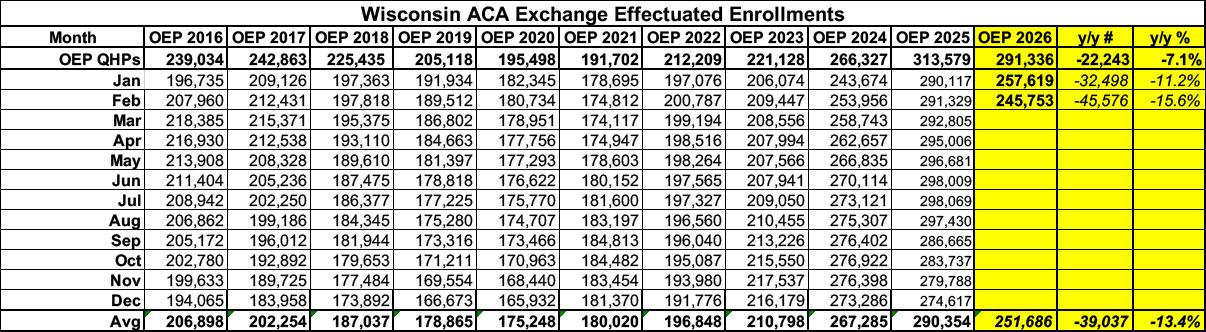
ACA exchange enrollment has dropped by over 15% in Wisconsin since Congressional Republicans allowed the enhanced federal subsidies to expire at the end of last year.
Initial signups during Open Enrollment were down 7% vs. OEP 2025...but effectuated enrollment was 11% lower year over year in January, rising to 15.6% lower as of February.
That's over 45,000 Wisconsinites who already lost coverage in just the first two months of the year...a number which has likely continued to climb since then.
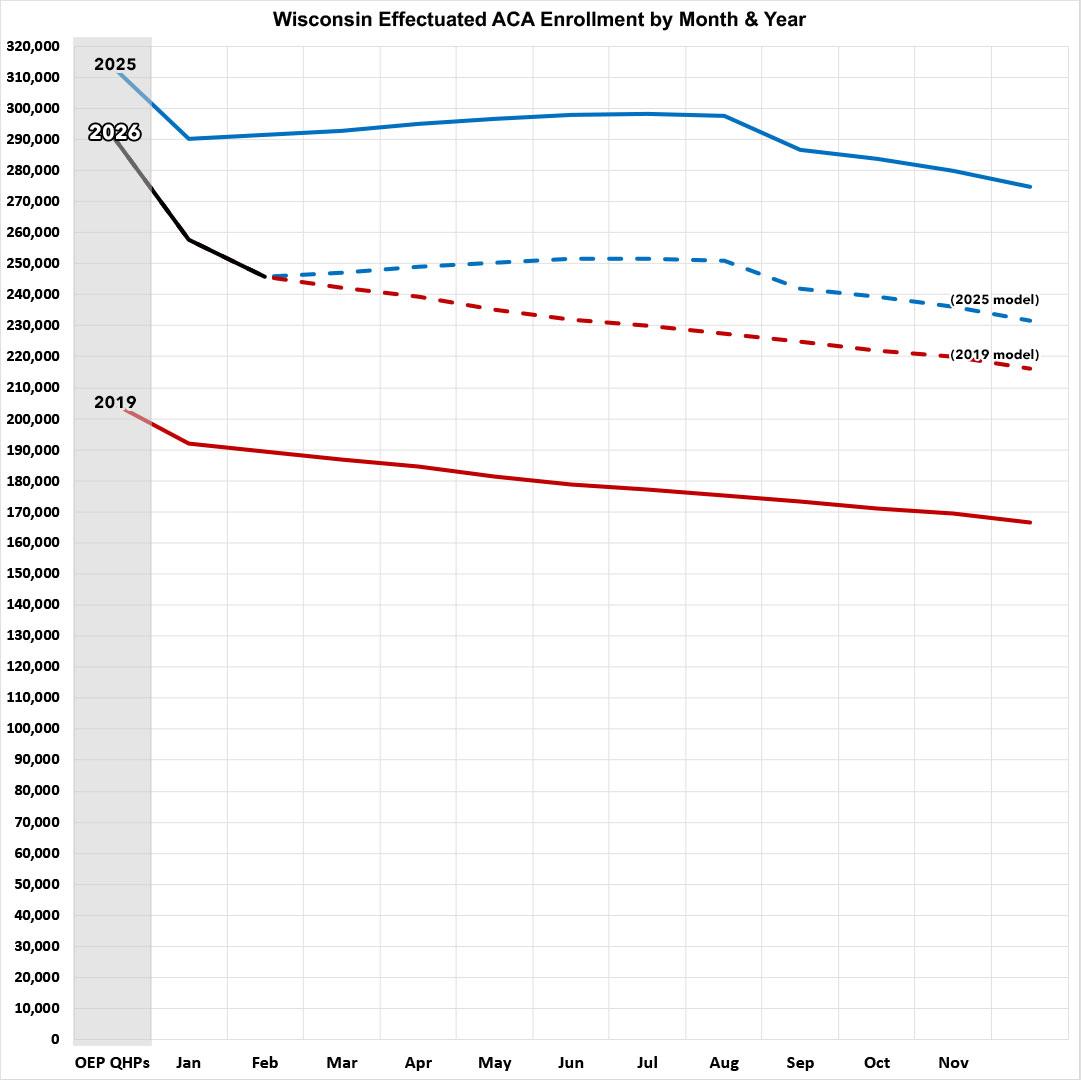
Here's what this looks like visually, with both 2025 and 2019 (the last pre-COVID year, which didn't include the enhanced subsidies) included for comparison:
Looking ahead to 2027, the preliminary rate filings for both the individual and small group markets are now available via the federal Rate Review database:
ASPIRUS ARISE:
The average proposed rate increase of 24.3%, effective January 1, 2027, is expected to impact 15,196 members, based on membership as of March 31, 2026. The rate increase varies by plan, ranging between 19.5% and 27.9%. Rate changes vary by plan due to the impact of changes in benefits and rating adjustments to account for the non-funding of Cost Sharing Reduction (CSR) payments.
Financial Experience of the Product
After accounting for payments into the risk adjustment program, Aspirus has an overall risk-adjusted MLR of approximately 106% in 2025. The proposed rate increase is intended to account for expected claims activity in 2027 given historical experience and any anticipated changes. With the proposed rate increase, the anticipated risk-adjusted MLR is expected to be 86% overall in 2027.
Changes in Medical Service Costs
Medical and prescription drug trend for these products is anticipated to be an average of 6.9% per year on allowed claims. This was developed based on historical experience, as well as consideration of information available on changes in the cost of services due to general medical and prescription drug inflation and changes in the anticipated utilization of services. For 2027 cost projections, adjustments to 2025 allowed claims consider population changes and costs. This includes factoring in expected disenrollments and non-effectuated membership resulting from the expiration of enhanced premium subsidies established in the American Rescue Plan Act at the end of 2025. The expiration of these subsidies may lead to higher average statewide morbidity, potentially increasing overall medical costs. We assumed a comparable impact as in 2026 pricing, resulting in no additional impact to 2027 rates.
Changes in Benefits
Changes in benefits have been made to these plans, leading to an aggregate 2.0% decrease in costs compared to 2025 experience. Any impact of benefit changes is reflected in the proposed rate changes.
Administrative Costs and Anticipated Profits
Aspirus anticipates having comparable administrative costs as a percent of premium compared to 2026. The federal exchange fees decreased from 2.5% to 1.9% of premium. Aspirus applies a risk margin of 2.0%, compared to 0% in 2026 pricing. Aspirus made a business decision in setting 2026 rates to accept a lower margin and minimize the rate increase impact to members, with consideration for the company’s capital position and financial viability. The lower 2026 rate increase was intended to provide greater stability of membership and allow Aspirus to continue to drive improvements to profitability. 2027 pricing reflects a risk margin shifting closer toward market norms. The overall impact of these changes is an increase to rates of 1.6%.
COMMON GROUND CO-OP:
This document contains the Part II written description justifying the rate increase subject to review on Common Ground Healthcare Cooperative’s (CGHC) individual medical block of business in Wisconsin, effective January 1, 2027. The average proposed rate increase is 30.9% and varies based on age, geographic region, and plan selection. There are 25,735 members currently enrolled that will be affected by the rate change.
Both costs and the number of services for medical and pharmacy benefits have increased significantly, which is the major contributor to this rate action. Changes in benefits are not a major contributor to the rate action and are within the bounds defined by CMS’ Final AV Calculator instructions. The expiration of ARPA and the resulting assumed reduction in total marketplace membership is a driver of increased administrative expenses in this filing.
COMPCARE/ANTHEM:
Compcare Health Services Insurance Corporation (Compcare) has made an application to the Wisconsin Office of the Commissioner of Insurance for a rate change of 16.4 percent, excluding the impact of aging, for its ACA-compliant individual health plan products effective January 1, 2027. At the individual plan level, the rate changes range from 6.7 percent to 30.0 percent. This increase will impact approximately 43,950 Wisconsin members renewing in 2027 with Compcare. The actual rate change for a subscriber could be higher or lower depending on the benefit plan selected, geographic location, age characteristics, and dependent coverage.
FINANCIAL EXPERIENCE
Compcare expects the proposed rate increase will cover projected medical trends and yield a medical loss ratio of 87.9 percent on an ACA basis, meaning at least eighty-seven cents of each premium dollar are expected to go to covering medical expenses and improving health care quality for our members. Please note that this MLR calculation is purely an estimate and not meant to be a true measure for Federal or State MLR rebate purposes. Also note that the projected Federal MLR presented here does not capture all adjustments, including but not limited to: three year averaging, credibility, and deductible. The projected MLR for Compcare is expected to meet or exceed the minimum MLR standards at the market level after including all adjustments. If the actual MLR is less than the Federal required minimum, Compcare will refund the difference to policyholders.
CHANGES IN MEDICAL SERVICE COSTS
The primary driver of the rate increase in the filing is the continued increase in the cost of healthcare. This is driven by increases in the price of services, or unit costs, primarily from hospitals, physicians and pharmaceutical companies, coupled with increases in the consumption of services, or utilization, by members. Increases in the unit costs of services are driven by technology advances, general inflationary pressures, and a variety of other factors. Changes in utilization of services can be driven by the aging of the population, benefit design and many other factors.
ADMINISTRATIVE COSTS AND ANTICIPATED PROFITS
Compcare continues to effectively manage administrative and selling costs. Anticipated profits are not expected to materially change such that the changes would impact the proposed rate increase. The Affordable Care Act requires that no less than 80 percent of a health insurer premiums go to medical expenses and improving health care quality, otherwise a premium rebate to subscribers must be generated to refund the difference. Accordingly, Compcare is filing premium increases targeting compliance with that requirement.
DEAN HEALTH PLAN:
Dean Health Plan (DHP) is requesting rate change for its individual market business in Wisconsin. The rate change will take effect on January 1, 2027 and will impact an estimated 43,412 members. The average rate change will be 19.40% by product and will result in rate changes that vary across plan designs.
DHP uses 2025 data from Wisconsin, which includes estimates of changes to the below through 2026:
- Population DHP expects to insure
- Cost of medical services
- Cost of pharmacy services
- Taxes and fees
The significant factors that impact the rate change include those listed above.
2) Financial Experience of the Product
In 2025, 88.0% of premium dollars went towards medical services after taxes and fees were removed. Under the ACA, individual products are required to pay at least 80% of premium dollars, after taxes and fees are removed, towards medical services. For 2027, DHP is expecting that 87.4% of premium dollars will be spent on medical services in Wisconsin
after taxes and fees were removed.
3) Changes in Medical Service Costs
Medical cost changes, in both number of services and costs of services, make up the largest increase to DHP’s premium rates. Additionally, impacts due to better rates with hospitals and doctors and reviewing recent experience also aid in determining premium changes. Finally, relationships with providers are helping to improve premium rates through a lower overall cost for care.
June 9, 20264) Changes in Benefits
DHP updates the plan designs offered each year, which impacts each plan’s cost-sharing (e.g. deductibles, copayments, etc.). These updates follow federal rules for how much of costs the insurance company will cover under that plan. Because these updates will be different for each plan, the rate changes will also be different by plan.
5) Administrative Costs and Anticipated Margins
DHP expects the cost to administer coverage per member per month (PMPM) for 2027 to be $79.20 which is higher than the 2026 cost. The main drivers of DHP’s administrative expenses are employee salaries and benefits, agent commissions, claim processing/IT, and clinical/network services.
GROUP HEALTH CO-OP:
This represents the average rate increase, including modifications to prior year benefits and other pricing adjustments. The average premium increase to consumers, before reflecting changes in age, is expected to be 16.4%. The range of rate changes, before reflecting changes in age, which consumers will experience, is approximately 13.1% to 19.5%.
(note that the effectuated enrollment number isn't included here)
2. CHANGES IN EXPERIENCE BASIS
GHC-SCW’s 2025 claims experience (with a loss ratio of 107.2%) was unfavorable relative to the 2024 claims experience used in developing 2026 rates.
3. CHANGES IN MEDICAL SERVICE COSTS AND TREND ASSUMPTIONS
The projection of claims from GHC-SCW’s experience period to 2027 includes an expected increase in the cost of all medical and pharmacy services. We developed these trend assumptions using general industry knowledge regarding recent trends in medical inflation, industry research, and judgment.
4. CHANGES IN BENEFITS
GHC-SCW will make cost sharing modifications by plan to comply with the final 2027 Actuarial Value Calculator and to align with GHC-SCW’s desired market position. To the extent the plan changes lead to a higher or lower level of benefit richness, the premium rates would increase or decrease, respectively.
5. CHANGES IN RISK ADJUSTMENT PROJECTION
GHC-SCW’s projected 2027 risk adjustment payable increased relative to the payable assumed in the 2026 rates.
6. CHANGES IN WIHSP RECEIVABLE PROJECTION
GHC-SCW’s projected 2027 WIHSP receivable decreased relative to the receipt assumed in the 2026 rates.
HEALTHPARTNERS:
The 2027 proposed average rate increase, as calculated in the URRT, is 15.59 percent. This rate increaseimpact s approximately 10,300 members. The increases vary by plan option, ranging from 12.7 percent to 18.5 percent for continuing bronze, silver and gold plans. The actual rate change for members will be different depending on the benefit plan, area, network, and age. Two Bronze plans have increases over 15% in 2027. These plans are 20173WI0130027 and 20173WI0130038 with increases of 17.1% and 18.5% respectively. Total membership on these two plans is 3,492 members.
HealthPartners is also terming off-exchange only HIOS IDs and crosswalking silver on-exchange Select NE WI plans to the broader Oak network for 2027.
- Off-exchange W WI Atlas silver members (HIOS IDs 20173WI0140006, 20173WI0140018, 20173WI0140002 and 20173WI0140034) would experience rate increases of 27%-33% if they enroll in the plan they are crosswalked to. The increase is due to the addition of silver loading which is included on the off-exchange rate.
- On-Exchange NE WI Select Silver members (HIOS IDs: 20173WI1030033, 20173WI0130034, 20173WI0130037) would experience increases of 32%-35% if they enroll in the Silver NE WI Oak network plan they are being crosswalked to for 2027. The increase is due to the broader network silver plans are offered under in 2027.
- Off-Exchange NE WI Select Silver members (HIOS IDs: 20173WI0140035, 20173WI0140022, 20173WI0140025 and 20173WI0140036) would experience increases of 50%-58% if they enroll in the Silver NE WI Oak network plan they are being crosswalked to for 2027. The increase is due to the broader network silver plans are offered under in 2027 as well as silver loading which is being added to the off-exchange plan.
Financial experience of the product:
According to the Supplemental Health Care Exhibit – Part 1 of the HealthPartners Insurance Corporation 2025 Annual Statement, HealthPartners experienced a 2025 loss on Wisconsin Individual products of $8.5 million with approximately $60 million in revenue and $68 million in claims. Higher than expected claims experience and risk adjustment charges led to the loss. The requested increase is projected to result in revenue that is adequate to cover claims and expenses in 2027.
Changes in medical service costs:
The projection of claims from the experience period to the rate effective period assumes a medical and pharmacy trend of 6.9 percent to 2026 and 8.5 percent to 2027 in W WI and 5.6% to 2026 and 10.8% to 2027 in NE WI. This includes both medical inflation and utilization increases; it reflects contractual changes in the payment to healthcare providers, expected increases in the costs of prescription drugs, and expected changes in the volume and types of services utilized by members. Additional increases in costs due to the termination of enhanced ARPA subsidies also result in higher rates.
Changes in benefits:
All ACA benefit plans must follow federal guidelines regarding the Actuarial Values allowed within each metal level. Every year as the Actuarial Value calculator is updated many plans need minor changes tocost-sharing to bring the plans back into the metal level ranges. This results in some premium increases and some premium decreases relative to the overall average rate change.
Administrative costs:
Our average annual administrative cost trend is lower than medical trend, thus administrative costs have a slight downward impact on the rate increase.
MEDICA:
Medica Community Health Plan (Medica) is requesting a rate change for its individual market business in Wisconsin. The rate change will take effect on January 1, 2027 and will impact an estimated 15,266 members. The average rate change will be 24.6% and will result in rate changes that vary across plan designs. This includes changes to the costs of care.
Medica uses 2025 data from Wisconsin, which includes estimates of changes to the below through 2027:
- Population Medica expects to insure
- Cost of medical services
- Cost of pharmacy services
- Taxes and fees
The significant factors that impact the rate change include those listed above. Claim costs per member per month are expected to change from $1,034.42 in 2025 to $1,223.98 in 2027.
2) Financial Experience of the Product
In 2025, 104.3% of premium dollars went towards medical services after taxes and fees were removed. Under the ACA, individual products are required to pay at least 80% of premium dollars, after taxes and fees were removed, towards medical services. For 2027, Medica is expecting that 89.3% of premium dollars will be spent on medical services in Wisconsin after taxes and fees were removed.
3) Changes in Medical Service Costs
Medical cost changes, in both number of services and costs of services, make up the largest increase to Medica’s premium rates. Additionally, impacts due to better rates with hospitals and doctors and reviewing recent experience also aid in determining premium changes. Finally, relationships with providers are helping to improve premium rates through a lower overall cost for care.
June 9, 20264) Changes in Benefits
Medica updates the plan designs offered each year, which impacts each plan’s cost-sharing (e.g. deductibles, copayments, etc.). These updates follow federal rules for how much of costs the insurance company will cover under that plan. Because these updates will be different for each plan, the rate changes will also be different by plan.
5) Administrative Costs and Anticipated Margins
Medica expects the cost to administer coverage per member per month (PMPM) for 2027 to be $80.98 which is higher than the 2026 value. The main drivers of Medica’s administrative expenses are employee salaries and benefits, agent commissions, claim processing/IT, and clinical/network services
MERCYCARE:
MercyCare HMO, Inc. (MercyCare) offers comprehensive and fully insured coverage to members in the Individual ACA market in the Wisconsin counties of Rock and Walworth. MercyCare is filing a rate increase for 2027 products. All plans will be offered statewide both on and off the Federally Facilitated Marketplace in Wisconsin.
The average rate change for individuals renewing in 2027, as shown in the URRT, is 28.01%, with the minimum and maximum rate changes equal to 25.70% and 31.27%, respectively. The proposed rate changes vary by plan due to changes in the paid-to-allowed ratios, induced utilization factors underlying the actuarial value and cost sharing components of the Plan Adjusted Index Rates, and the premium load applied to cost-sharing reduction plans. The paid-to-allowed ratios for all plans were updated to reflect the anticipated claim costs associated with the projected 2027 MercyCare Individual ACA population.
(again, unfortunately the effectuated enrollment isn't included in this memo)
The primary drivers of the average rate change are summarized below:
• Experience and Trend: We estimate that the impact of one additional year of trend and changes to the experience underlying the base period and manual rate have an impact of approximately +22.6% on the rates.
• Morbidity, Risk Adjustment, and Demographics: We estimate the impact of changes in the morbidity of the population, risk adjustment, and demographics of the population have an impact of +4.1% on the rates. This includes the continued impact of the expiration of enhanced premium tax credits.
- Administrative Expenses: Changes in administrative expenses are estimated to have an impact of -0.2% on the rates.
- Rate changes vary by plan due to the following
- updated paid to allowed ratios reflecting updated to Oliver Wyman’s pricing model;
- induced utilization impact;
- and impact of CSR loading on silver plans.
The annual trend assumption is 9.22%. This reflects the anticipated changes in cost due to contracting and utilization for both medical and pharmacy claims.
MOLINA:
MolinaHealthcare.com July 13, 2026
Office of the Commissioner of Insurance
Attn: Commissioner HoudekRe: Molina Healthcare of Wisconsin, Inc. (HIOS ID: 52697) – Notice of Intent to Withdraw from the Individual Market
Dear Commissioner Houdek,
We are writing to inform you that Molina Healthcare of Wisconsin, Inc. plans to withdraw from the Wisconsin Individual Market, including all Qualified Health Plan offerings, effective January 1, 2027.
At this time, Molina offers one off-exchange Individual HMO plan in Wisconsin; however, there is no current membership enrolled. Because of this, member discontinuation notices are not required at this time. This is not a mid-year change, and Molina will continue to handle any claims run-out and provide customer service support, as needed, in line with applicable requirements.
We are committed to meeting all applicable state and federal requirements related to this withdrawal and are happy to provide any additional information the Office of the Commissioner of Insurance may need.
NETWORK HEALTH PLAN:
Network Health has requested an average rate increase of 23.5% effective January 1, 2027. Rate increases range from 14.1% to 40.6% and vary by plan and geographic area. This affects 39,901 members as of March 31, 2026.
2. Financial Experience of the Product
Network Health’s loss ratio for 2025, as reported in the 2027 Uniform Rate Review Template, was 95.3%. With the requested rate increases, the projected loss ratio for 2027 is expected to be 85.2%.
3. Changes in Medical Service Costs
The primary contributor to the rate increase is medical inflation. We expect claims to increase at an annualized rate of 8.0%. Additional contributing items include higher utilization of services and higher morbidity for our ACA population, which have resulted in higher claims costs and medical loss ratios significantly above pricing targets. Changes in provider contracts and provider mix contribute to the rate change as well.
4. Changes in Benefits
Covered services have not materially changed for 2027. However, Network Health made changes to member cost sharing for 2027 in order to keep the plans in the actuarial value ranges required by federal law and to adjust benefit levels to account for medical inflation.
5. Administrative Costs and Anticipated Margins
Administrative costs are expected to decrease as a percentage of premium. This reduction lowered the overall rate increase needed for 2027.
QUARTZ HEALTH BENEFIT PLAN:
Quartz Health Plan Benefits Corporation (Quartz) is requesting an average rate increase of 16.83%. Quartz members would receive premium increases ranging from -13.99% to 32.86%, depending on their plan selection. As of March 2026, there are 15,155 individuals that will be impacted by this increase. Additionally, premium rates may change for individual contracts by an amount outside of the filed rates due to changes occurring at the contract level. These contract level changes may include changes in various characteristics, such as age, benefit plan, and tobacco user status.
Financial Experience of the Product
The proposed rate increase is needed in order to maintain a target projected loss ratio of 89.47%. Please note that this MLR calculation is purely an estimate and not meant to be a true measure for purpose of calculating the Federal or State MLR rebates. The products contained in this filing represent only a subset of Quartz’s Individual business.
Changes in Medical Service Costs
The requested rate increase is impacted by both medical and pharmacy trends increasing due to utilization and service cost changes.
Utilization Changes – A portion of the rate increase is due to the changes in claim costs associated with utilization increases from the number of services, severity of services and change in mix of services.
Service Cost Changes – A portion of the rate increase is due to the changes in the plan claim costs due to increased reimbursement payments to healthcare providers.
Changes in Benefits
Quartz has made some minor cost sharing changes to current plan designs to maintain compliance within the federally mandated benefit ranges. The increase in the federal Maximum out of Pocket for 2027 from $10,600 to $12,000 for a single individual has resulted in some plans experiencing smaller cost increases than other plans.
Administrative Costs and Anticipated Margins
Administrative Costs as a percentage of premium are decreasing by 0.80% from 2026 to 2027. This has reduced the overall needed rate increase. For 2027, Quartz has no changes to its anticipated margin as a percentage of premium.
SECURITY HEALTH PLAN:
(FULLY REDACTED)
UNITEDHEALTHCARE OF WI:
UHCWI is filing 2027 rates for individual products. The proposed rate change is 23.72% and will affect 23,922 individuals. The rate changes vary between 19.74% and 25.05%. Given that the rate changes are based on the same single risk pool, the rate changes vary by plan due to plan design changes.
Financial Experience of the Product
The premium collected in plan year 2025 was $217,140,714. Incurred claims net of reinsurance during this period were $204,731,444 and UHCWI expects payments of $25,110,037 for risk adjustment. The benefit claims ratio, or portion of premium required to pay medical claims, for plan year 2025 is 105.85%.
Changes in Medical Service Costs
There are many different healthcare cost trends that contribute to increases in the overall United States healthcare spending each year. These trend factors affect health insurance premiums, which can mean a premium rate increase to cover costs. Some of the key healthcare cost trends that have affected this year’s rate actions include:
• Increasing cost of medical services: Annual increases in reimbursement rates to healthcare providers, such as hospitals, doctors, and pharmaceutical companies.
• Increased utilization: The number of office visits and other services continues to grow. In addition, total healthcare spending will vary by the intensity of care and use of diverse types of health services. The price of care can be affected by using expensive procedures such as surgery versus simply monitoring or providing medications.
• Higher costs from deductible leveraging: Healthcare costs continue to rise every year. If deductibles and copayments remain the same, a higher percentage of healthcare costs need to be covered by health insurance premiums each year.
• Impact of innovative technology: Improvements to medical technology and clinical practice often result in the use of more expensive services, leading to increased healthcare spending and utilization.
• Changes in market morbidity: Premiums reflect the expected increase in the average cost per member due to healthier members leaving the market due to the expiration of enhanced APTCs.
Changes in Benefits
Changes in benefits impact costs and therefore affect premium changes. Typically, plan b nefits are changed for one of three reasons: to comply with the requirements of the Affordable Care Act or state law, to respond to consumer feedback, or to address a particular medical cost issue to provide greater long-term affordability of the product.
The Affordable Care Act implemented requirements for the “value” that must be offered by plan designs in the Individual and Small Group markets. These are called “metal levels.” For a benefit plan to remain classified within a particular metal level from year to year, adjustments to deductibles, copayments or coinsurance are sometimes required. These adjustments impact the cost and therefore the premium increases for the plan.
Administrative Costs and Anticipated Margins
UHCWI works to directly control administrative expenses by adopting better processes and technology and developing programs and innovations that make healthcare more affordable. We have led the marketplace by introducing key innovations that make healthcare services more accessible and affordable for customers, improve the quality and coordination of healthcare services, and help individuals and their physicians make more informed healthcare decisions.
Taxes and fees imposed by the state and federal government are significant factors that impact healthcare spending and must be included as additional administrative costs associated with the plans. These fees include Affordable Care Act taxes and fees which impact health insurance costs and need to be reflected in premium. Another component of premium is margin, which is set to address expected volatility and risk in the market.
We anticipate that the requested rate change will be sufficient to cover the projected benefit and administrative costs for the 2027 plan year.
WI PHYSICIANS SERVICE (WPS):
n/a
Unfortunately, I wasn't able to acquire effectuated enrollment data for three of the carriers participating in Wisconsin's individual market next year (Group Health Co-OP, MercyCare HMO and Security Health Plan of WI), so I've had to come up with an educated guess based on the confirmed on-exchange total market enrollment of ~246,000 as of February. Assuming roughly ~29,000 off-exchange enrollees as well, that would leave roughly ~42,000 across these three carriers, or perhaps ~14,000 apiece.
Assuming that's roughly accurate, this puts Wisconsin's overall weighted average preliminary rate increase for 2027 at a whopping 21.1%.

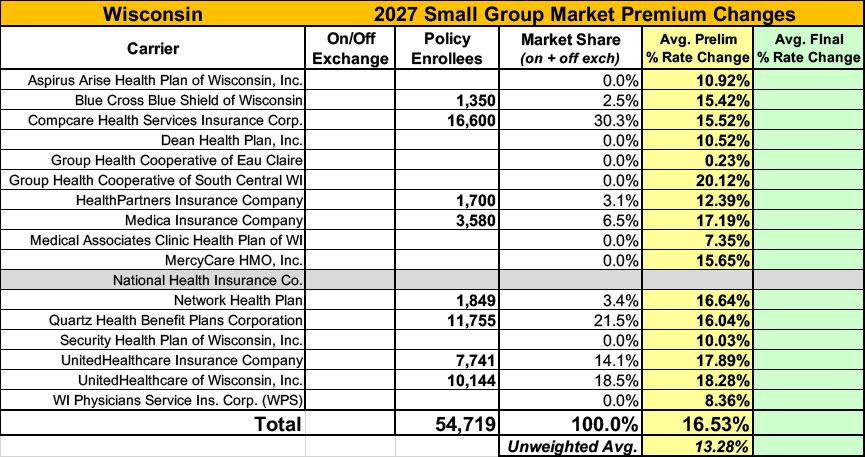
As for Wisconsin's small group insurance market, while I can't run a weighted average rate increase due to only having effectuated enrollment data for half the carriers (and I don't even have a statewide total to work with) the unweighted average increase being asked for is 13.3% across all 16 carriers.
Advertisement


